
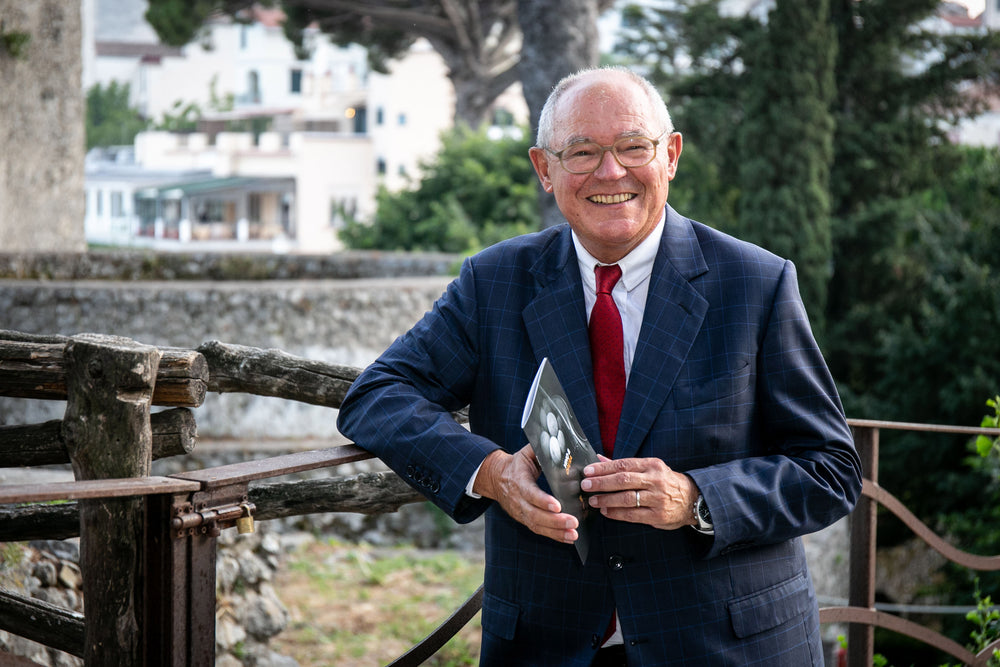
ANTON F. BOERNER'S WINNING BET - FOUNDER OF ÔMINA ROMANA
by Maria Carla Magni
Anton F. Boerner, a German entrepreneur of Bavarian origin, has held Italy dear to his heart since childhood, when he used to spend his summer vacations there at the age of five. His passion for Italy then evolved into a deep love for archaeology, history, philosophy, art, and culture, leading him to establish a company that would bring together all his knowledge to realize a dream: the creation of Ômina Romana, a winery in an area that was still relatively unknown at the time. His family has always been by his side in building the company, but above all his wife Anna Maria, who is, of course, Italian and has always been his partner in entrepreneurial decisions. Today, the company is also led by his daughter Katharina, the CEO, and an extended family consisting of his trusted and valued collaborators.

-Since you founded the Ômina Romana project in 2007, would you say that you have finally succeeded in a venture that seemed very ambitious at the time? In reality, I feel that we are simply on the right track. We haven’t yet reached all the foreign markets we intend to enter, but I admit that a great deal has been accomplished since the beginning—though just as much still needs to be done.
- What were the main challenges and the greatest achievements over the past 16 years?
Initially, the greatest challenge was undoubtedly staff training.
To build the company we envisioned, it was essential to have well-trained employees, and this was a rigorous commitment to which we devoted significant effort.
First and foremost, the work of our agronomist, Dr. Paula Pacheco, was fundamental. She managed to translate all the scientific expertise, gathered in close collaboration with the University of Florence, into practical results, achieving what initially seemed difficult.
Today I can say I am proud of our team, capable of working with sophisticated techniques, managing to create a final product of excellence, combining manual skill and scientific knowledge.
This satisfaction is further rewarded by the quality of our wines when compared to major international labels, a fact consistently confirmed by various “blind tastings” that validate these results.
This satisfaction is not only personal but shared with all our collaborators—from the cellar to the vineyard, and throughout our distribution network in Italy and abroad.
We all feel like one big family, and our success stems from our shared commitment, free from hierarchies.


-Ômina Romana is a family-run business; your daughter Katharina has taken over as CEO, and you collaborate with expert professionals. What is your role in the company today?
Personally, I spend the entire year promoting the brand in Italy and Europe, with the aim of sharing the history and passion of our company for what it produces.
People, in turn, become curious because they want to get to know the “spiritus rector”—the driving force—behind the product and truly understand how much meticulous work goes into a label and the work of Ômina Romana.
I get very passionate when, during the various masterclasses, tastings, and events, people become curious about our history and culture as an essential backdrop to our wine.
In this process of sharing product knowledge with various clients, my daughter Katharina and I have divided the different market areas: I focus on Italy and Europe, while she handles the markets in Asia and the United States.

- You have always been passionate about Italian art, history, and culture: how have you managed to combine this passion with your love for wine, and what is the added value that defines the concept of Ômina Romana?
My passions for art and history align perfectly with the concept of Ômina Romana, as it represents the renaissance of Etruscan-Roman wine.
Through my studies, I discovered that the Etruscans pioneered viticulture in this region, a tradition the Romans later continued by planting the most prestigious grape varieties of the Roman era in our area, near Velletri, which were subsequently distributed throughout all the conquered territories of the empire.
Our project is precisely to revive the spirit of what was once the great wine of antiquity and make it known throughout the world.
We work on a wine that has deep roots in history, extending to the present day, thanks also to new technological tools and the most innovative scientific research.
We also establish this connection through the names of our labels, which derive from the classical Greek and Roman periods.
The philosophy of the early Christian centuries also plays an important role, which we express through the concepts of "mens et manus" (mind and hand) and "ora et labora" (pray and work). All of this has a strong connection for us with the manual skill of viticultural work in the company and is unique to our territory.

- How, if at all, has the wine sector in the region changed over the course of this journey? I see the Ômina Romana project for our region as something of a wild card—meaning everyone follows their own path. We have decided to follow the one we feel best represents us.
- How do you see the future, and what are the next steps you plan to take for the company? Our goals remain the same: to work meticulously and continue to build our brand’s presence in untapped markets. And, of course, to continue working on product quality together with “our family of collaborators.” Looking ahead, we certainly hope to double the winery’s production capacity and maximize the potential of our land.

- Is there a particular wine for 2023 that you’re betting on?
Yes! We began testing a pure Merlot Rosé last year. It was so popular that it sold out in just a few months.
With the new harvest, we’ve increased production capacity for this wine, and we’ll be showcasing it at both the upcoming Vinitaly and Prowein.
So, it will certainly be a big gamble and a new product for us to launch, but a very interesting one thanks to its characteristics: freshness and extraordinary aromas of grapefruit, cedar, and citrus. Absolutely ideal for the coming summer.
I therefore invite everyone to try it and hope to meet many Ômina Romana enthusiasts soon, both at the winery for a visit and in various parts of Italy and Europe at our Masterclasses.


Seit etwa 20 Jahren leide ich unter einer plötzlichen,ausgeprägten ( Pulsanstieg, Atemnot)Histaminallergie. Rotweine zu trinken war absolut tabu weil Rotweine einen hohen Histamingehalt haben können, besonders französische.Weshalb "war" ?
Zufällig wurde ich dieses Jahr mit einem Rotwein konfrontiert, aus Ihrem Weingut. Dem Cabernet Sauvignon Linea Ars Magna 2015. Als Histaminallergiker erkennt man einen Histamin haltigen Wein schon am Geruch. Die Nase ist "metallisch."
Hier fehlte dieses Merkmal völlig. Der Wein, mutig getrunken, hinterliess keinerlei allergische Reaktion. Inzwischen ebenso der Merlot. Endlich wieder Rotwein. Als Mediziner empfehle ich Ihnen, auf diesen Aspekt, zumindest dieser beiden Sorten hinzuweisen. Selbstverständlich ist der Grund für das fehlende oder zumindest rudimentäre Histamin eine Folge des Ausbaus Ihrer Weine. Sie sollten diese Eigenschaft erwähnen. Z.B. "histaminarm." Histaminfrei würde ich aus rechtlichen Gründen nicht empfehlen. Wie gesagt, Sie haben einem Gourmet nach Jahren des Verzichts ein grosses Geschenk gemacht. Auch wenn Sie dies vielleicht nicht wussten. Mit freundlichen Grüsse, Dr. Wolfgang Bonz